
It’s Kind of a Funny Story: Why Comedy Writer Brian Finkelstein Self-Published His Debut Novel
/First, congratulations on the publication of The Triumph of Jules Coletti! Could you tell us a little about this novel and your inspiration for it?
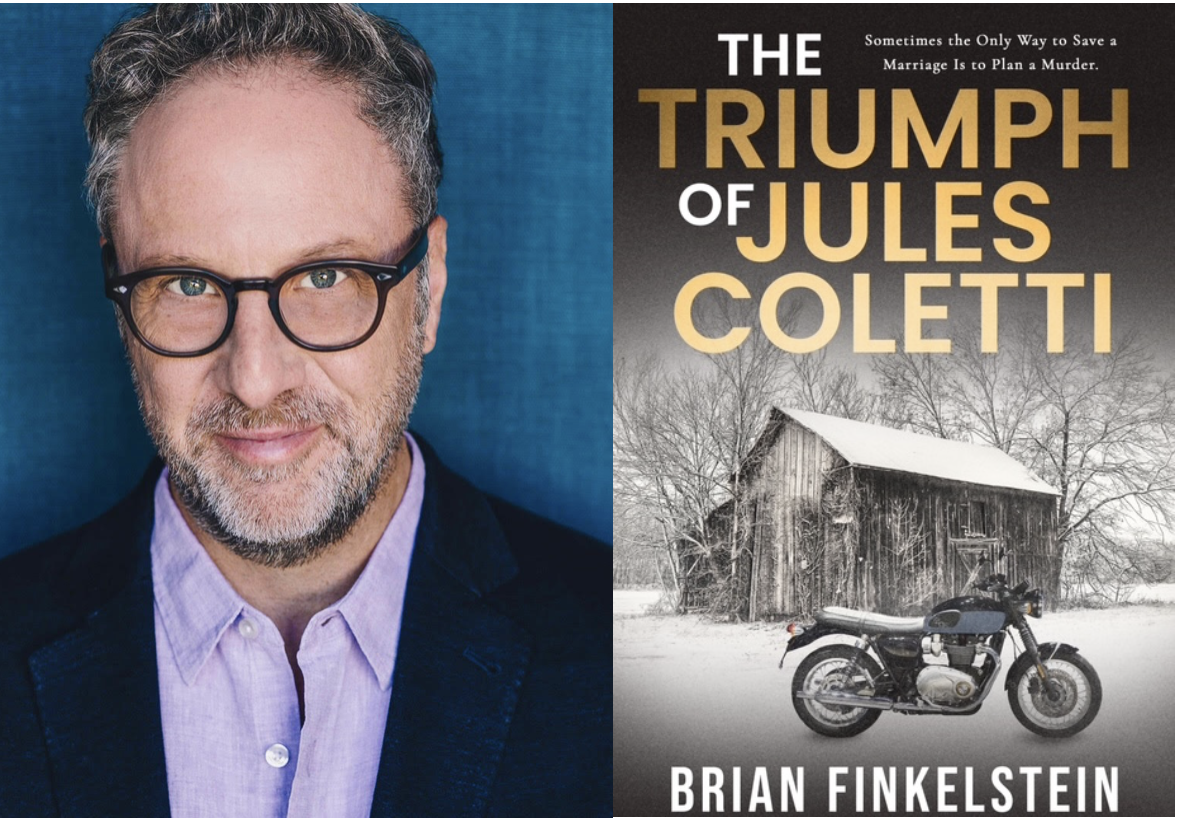
My novel is based on my mom freaking out about the 2016 election. She was calling me every day, saying, “How could this happen?” “How come no one is doing anything about it?” And it felt as though a lot of us were feeling that way—like this terrible thing had happened and we were all waiting for someone to do something about it. Only, no one did. So I imagined: what if my mom did?
Then, when I started to write Jules’s character, she took on a life of her own. It seemed to me that many older women (and men) read thrillers and crime novels, but they hardly ever see themselves in them. Usually, the protagonists are in their 30s or 40s. I wanted to write a book not only about my mom, but for my mom. And that’s what inspired me.
At first, I wrote a screenplay, and then it became a novel: the story of a 70-year-old grandmother who has never committed a crime in her life, but who is actively planning the murder of a man who just won an election. Let me say here, this is fiction, as in not real. I in no means encourage or support violence for any reason.
I do, however, enjoy it as a fun fantasy, and even find it cathartic. I also have a sentimental side and love books with real romance in them, so I set out to write a version of one of my favorite books, The Bridges of Madison County, about older people finding love—as if Quentin Tarantino wrote a fun revenge fantasy.
When you first contacted me in January 2024, you said that you had been querying agents but without any luck. What prompted you to end your agent search and self-publish? Your protagonist Jules’s main goal)? A certain event last summer that demonstrated how closely life can imitate art?
The agent search was grueling and disappointing. I did get a few people who were interested. But the same week I sent out the bulk of my query emails—July 2024—there was an actual attempt on the life of someone running for President. A man who is very litigious and then doxing became a thing. People were reluctant to have anything to do with me.
Then I started looking into self-publishing and was about to put my book out in September of this year, but another political assassination happened. It felt like the wrong time to release a book with a planned political assassination as the main plotline. Despite the fact that my book is not about culture wars or politics, and that my 2016 president-elect is fictitious and unnamed, it turned a lot of people off. I get that. So here we are.
What have you enjoyed most about the process of self-publishing, and what challenges have you faced? Some people say that “self-publishing” is a misnomer because it implies a solo effort. Do you agree?
It was a great entry point for me, as someone with no experience with the publishing world. Having complete control is a plus. But I agree that “self-publishing” is a misnomer. I ended up paying someone to handle much of the self-publishing process, and David at Author Imprints was great; I can’t recommend him enough. I just don’t think I’ll self-publish in that way again. It’s expensive, and at the end of the day, it’s really hard to promote your book or get it out into the world through that route.
I didn’t expect to make money on this project, but I would like more people to read it. I’m proud of it, and I think it’s very timely. I also think a lot of people would find it cathartic to read about a different historical outcome. But I don’t know how to get it out there beyond my small circle of friends, family, and the fans of my comedy over the years, which is honestly a pretty small group compared to what a traditionally published novel can reach.
You’re also a stand-up comedian, screenwriter, and an (Emmy-nominated!) TV writer. How has this background affected your novel writing?
As for the writing process, it helped because I know how to waste time productively. I know how to get through insecurities, to push past writer’s block, all of that. But as someone who mostly writes in Final Draft (a screenwriting software), I tend to see stories very visually. In the writing world I’ve lived in, you have to be so tight with description and even page count. You have to be really economical and say things bluntly and sometimes un-artistically, just to make sure people know what you want to say. That seems counterintuitive to novel writing, but once I locked in on that writing style, I really loved it.
On your website you write, “I have had way more failures than successes. I have written so many things that made no money.” Thank you for your honesty! What inspires you to keep writing without the promise of monetary or other rewards? And do you have other writing projects in the pipeline?
Yeah, I think that a lot of successful writers have projects that don’t sell, or that they start and stop, or that they can’t finish and keep coming back to. For me, I just love writing. I have to do it. It’s my therapy, and sometimes I do it instead of exercising. It just makes me feel better and clears my head. I’m constantly thinking about angles and stories. I think it’s more of a comedian’s mindset—to look at everything from an analytical point of view and try to see the funny, the interesting, the weird, the unusual, the common, or whatever. I can’t seem to stop that.
Maybe that’s a problem with my career, you know? I like the writing the most. I don’t really care if things get sold or made or even sometimes read. Other writer friends of mine tell me they are jealous of my love of the process part of writing. The creativity for creativity’s sake. But financially, it hasn’t always been advantageous, and I’m jealous of friends who can market themselves better. When I was younger, I was resentful, but now that I’m older, I realize that’s a skill I should’ve nurtured and developed.
And yes, I am writing something else, a new novel that explores the idea of class and how our culture thinks about money. I think I’m hooked on novels—for the simple reason that I have control over them. If I were 20, I might still write scripted content. And sure, I could make the film myself and put it online. But with a book, I can do the same thing creatively. I can write it, enjoy the process, be excited by it, finish it, and then I don’t have to “make” it. It’s already made.
Do you have any other advice for writers who are querying agents and/or considering self-publishing?
Like I said above, my advice is to make sure you know how to promote yourself. You have to do it, even if it feels gross; you have to. As far as querying literary agents, I don’t know. I clearly wasn’t good at it. I have multiple agents—and even they all passed on it. I would say just be honest. Tell the agent you’re querying the truth and be honest with yourself about what you’re writing.
As for self-publishing, I think the first thing you need to do is figure out what you want out of this. If you want to reach a wide audience, and you have an online presence or a guaranteed built-in couple of thousand people who you know will read your book, then by all means, self-publish. But I don’t see any reason not to try the traditional route first.
That being said, if you’ve written a book and you don’t get any traction, kind of what happened to me, put it out there. Why not? A friend told me, “You wrote a book. Just put it out there.” That’s why I self-published. I was going to let it go nowhere because I was kind of embarrassed to self-publish, but now I’m glad I did. I’m getting people I don’t know reaching out to me online to say they liked it. Not a lot, and not in the thousands, but it’s kind of cool, and I appreciate it.
(Photo credit: robmainordphotography.com)
Note: For a full list of my author interviews, click here.